
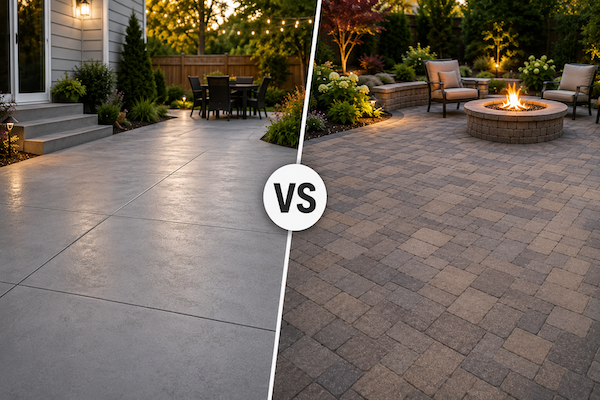
If you’re planning a new patio, one of the first decisions you’ll face is choosing between a concrete slab and pavers. At first glance, both options seem similar. They create a solid outdoor surface, can handle furniture and foot traffic, and can last for years when installed correctly.
However, once you start digging into the details, the differences become much more significant.
I’ve seen homeowners spend weeks choosing outdoor furniture while making a rushed decision on the patio surface itself. Unfortunately, the patio material will likely impact your long-term satisfaction more than anything you place on top of it.
So, which is better: a concrete slab or pavers?
The honest answer is that it depends on your budget, design goals, maintenance expectations, climate, and how you plan to use the space. In this guide, we’ll compare both options in detail and help you determine which solution makes the most sense for your backyard project.
Look at these topics for more idea about hardscape at this page HERE.
Understanding the Basics
Before comparing them, let’s quickly define each option.
What Is a Concrete Slab Patio?
A concrete slab patio is a continuous surface created by pouring wet concrete into forms and allowing it to cure.
It can be:
- Plain gray concrete
- Stamped concrete
- Colored concrete
- Exposed aggregate concrete
Concrete slabs create a smooth, uninterrupted patio surface.
What Is a Paver Patio?
A paver patio is made from individual units installed over a compacted gravel and sand base.
Common materials include:
- Concrete pavers
- Brick pavers
- Natural stone pavers
Each piece interlocks or sits closely together to create the finished patio surface.
Quick Comparison Table
| Feature | Concrete Slab | Pavers |
|---|---|---|
| Initial Cost | Lower | Higher |
| Design Flexibility | Moderate | Excellent |
| Repairability | Difficult | Easy |
| Crack Resistance | Lower | Higher |
| Installation Speed | Faster | Slower |
| Maintenance | Low to Moderate | Moderate |
| Property Value Impact | Good | Excellent |
| Lifespan | 20-30 Years | 30-50+ Years |
| Drainage Options | Limited | Better |
| DIY Friendliness | Moderate | Moderate to High |
Cost Comparison
For many homeowners, budget becomes the deciding factor.
Concrete Slab Costs
Concrete patios generally cost less upfront because:
- Fewer materials are needed
- Installation is faster
- Labor requirements are lower
A standard concrete patio is often the most affordable option for large outdoor spaces.
However, decorative upgrades such as:
- Stamped concrete
- Custom coloring
- Decorative borders
can significantly increase costs.
Paver Patio Costs
Pavers typically require:
- Base excavation
- Gravel foundation
- Bedding sand
- Individual paver installation
- Edge restraints
As a result, installation costs are usually higher.
However, many homeowners view pavers as a long-term investment due to their durability and visual appeal.
Winner for Budget
Concrete slabs.
If minimizing upfront cost is your primary goal, concrete usually wins.
Concrete path maker |
|---|
 |
Appearance and Design Flexibility
This is where pavers often shine.
Concrete Patio Appearance
Concrete offers a clean, simple appearance.
Modern techniques allow:
- Decorative stamping
- Color pigments
- Exposed aggregate finishes
While attractive, the design options are somewhat limited compared to pavers.
Paver Patio Appearance
Pavers offer nearly endless combinations.
Homeowners can choose:
- Multiple colors
- Various textures
- Different shapes
- Unique patterns
Popular layouts include:
- Herringbone
- Running bond
- Basket weave
- Random pattern
Pavers also create a higher-end appearance that many homeowners associate with luxury landscaping.
Winner for Appearance
Pavers.
The design flexibility is difficult to match.
Durability and Longevity
A patio is a long-term investment, so durability matters.
Concrete Slab Durability
Concrete is extremely strong under compression.
However, concrete has one unavoidable characteristic:
It cracks.
The question is not whether concrete will crack but when and where.
Control joints help manage cracking, but some movement is almost inevitable over time.
Factors that contribute to cracking include:
- Soil movement
- Freeze-thaw cycles
- Tree roots
- Poor installation
Paver Durability
Pavers are designed differently.
Because they consist of individual pieces, they can move slightly without developing large visible cracks.
This flexibility helps them handle:
- Ground movement
- Seasonal expansion
- Minor settling
Individual pavers can also be replaced if damaged.
Winner for Durability
Pavers.
Their modular design gives them a significant advantage over concrete slabs.
Maintenance Requirements
Every patio requires some level of upkeep.
Concrete Maintenance
Concrete maintenance is relatively simple.
Typical tasks include:
- Cleaning
- Occasional sealing
- Crack repair
The challenge comes when significant cracking occurs.
Repairs are often visible and difficult to blend into the original surface.
Paver Maintenance
Paver patios require:
- Joint sand replacement
- Weed management
- Occasional re-leveling
However, repairs are usually easier because individual pavers can be removed and replaced.
Winner for Maintenance
Tie.
Concrete requires less routine attention, while pavers are easier to repair.
Drainage Performance
Drainage is often overlooked until problems appear.
Concrete Drainage
Concrete relies on proper slope design to move water away.
If installed incorrectly, water may pool on the surface.
Paver Drainage
Paver systems naturally allow some water movement through the joints.
Permeable pavers improve drainage even further.
This can reduce:
- Puddling
- Runoff
- Surface water accumulation
Winner for Drainage
Pavers.
Especially permeable systems.
Installation Complexity
Concrete Installation
The process generally involves:
- Excavation
- Base preparation
- Form setup
- Concrete pouring
- Finishing
- Curing
While faster, timing is critical because concrete begins hardening immediately.
Mistakes are difficult to fix once the pour starts.
Paver Installation
Paver installation requires:
- Excavation
- Base preparation
- Compaction
- Sand installation
- Paver placement
- Edge restraints
- Polymeric sand
The process takes longer but allows for adjustments during installation.
Winner for DIY Projects
Slight advantage to pavers.
Many homeowners find pavers more forgiving because individual mistakes can be corrected during installation.
Climate Considerations
Climate plays a major role in patio performance.
Cold Climate Regions
Areas with frequent freeze-thaw cycles can be challenging for concrete.
Water enters small cracks and expands when frozen, gradually widening the damage.
Pavers generally perform better because they accommodate movement.
Warm Climate Regions
In warmer areas, both materials perform well.
Concrete may become hotter under direct sunlight, especially darker colors.
Some pavers remain cooler depending on material and color selection.
Winner in Cold Climates
Pavers.
User Feedback and Real Homeowner Experiences
After reviewing homeowner discussions, contractor forums, landscaping communities, and renovation groups, several patterns consistently emerge.
Why Homeowners Prefer Concrete
Users often mention:
- Lower installation cost
- Clean modern appearance
- Minimal routine maintenance
- Fast installation process
Many homeowners with large patios appreciate the affordability of concrete.
Why Homeowners Prefer Pavers
Paver owners frequently highlight:
- Premium appearance
- Better resale appeal
- Easier repairs
- Fewer concerns about cracking
Many homeowners who initially considered concrete eventually chose pavers because they wanted a more customized outdoor space.
Common Complaints About Concrete
The most frequent issues include:
- Cracking
- Surface discoloration
- Difficult repairs
- Settlement problems
Once significant cracks appear, repairs rarely become invisible.
Common Complaints About Pavers
Paver owners occasionally report:
- Weed growth between joints
- Ant activity
- Higher installation costs
- Joint sand maintenance
However, most users still express high satisfaction years after installation.
Pros and Cons Table
| Concrete Slabs Pros | Concrete Slabs Cons |
|---|---|
| Lower upfront cost | Cracks over time |
| Faster installation | Repairs often visible |
| Simple maintenance | Limited design flexibility |
| Good for large patios | Drainage challenges possible |
| Smooth surface | Less adaptable to movement |
| Pavers Pros | Pavers Cons |
|---|---|
| Highly attractive appearance | Higher initial cost |
| Easy to repair | More installation labor |
| Better crack resistance | Weed growth possible |
| Excellent design flexibility | Joint maintenance required |
| Superior drainage options | Material costs can be higher |
How to Choose Between Concrete and Pavers
Choose a concrete patio if:
- Budget is the top priority
- You want a simple design
- You need a large patio area
- You prefer lower upfront costs
Choose a paver patio if:
- Long-term durability matters most
- You want premium aesthetics
- Easy repairability is important
- You value design flexibility
- You plan to stay in the home for many years
Which Patio Option Adds More Value?
Real estate professionals and landscape designers often report that well-designed paver patios create a stronger visual impression during home sales.
Buyers tend to view pavers as a premium upgrade.
While concrete certainly adds value, pavers often contribute more to perceived luxury and outdoor living appeal.
Final Verdict
If you’re looking for the lowest-cost patio solution and prefer a simple, clean appearance, a concrete slab remains a practical choice. Modern decorative concrete can look attractive and provide decades of service when installed correctly.
However, if you’re looking for maximum durability, design flexibility, easier repairs, and a higher-end outdoor living space, pavers are usually the better long-term investment.
In many homeowner surveys and contractor discussions, people who install pavers rarely regret spending the extra money. On the other hand, cracked concrete is one of the most common patio complaints reported years after installation.
For homeowners planning to enjoy their backyard for many years, pavers often deliver the best combination of beauty, performance, and long-term satisfaction.
Disclaimer
This content is based on information from various sources and represents recommendations according to available data. Quality and correctness of products are the responsibility of manufacturers and sellers.
Leave a Reply