
Introduction
Quick answer: A Patagonia quartzite slab is a Brazilian natural stone with a bold mix of cream, beige, black, gray and brown crystals, translucent quartz areas and thin golden veins. Its translucent zones let it be backlit, so it is a favorite for feature walls, bars, islands and vanities. It is hard and heat resistant, but many slabs have resin-filled fissures, so it needs sealing, trivets and an experienced fabricator.
Patagonia is not a quiet stone. Where Taj Mahal or Statuario offer calm white backgrounds, Patagonia looks like a mosaic of broken crystals frozen in place. It is the stone people choose when they want the counter or wall to be the main piece of art in the room.
That drama comes with some practical points. This profile covers its look, where it comes from, how it is classified, where it works in a South Florida home and how to care for it. For a calmer quartzite, see our Taj Mahal quartzite profile.
What Does Patagonia Quartzite Look Like?
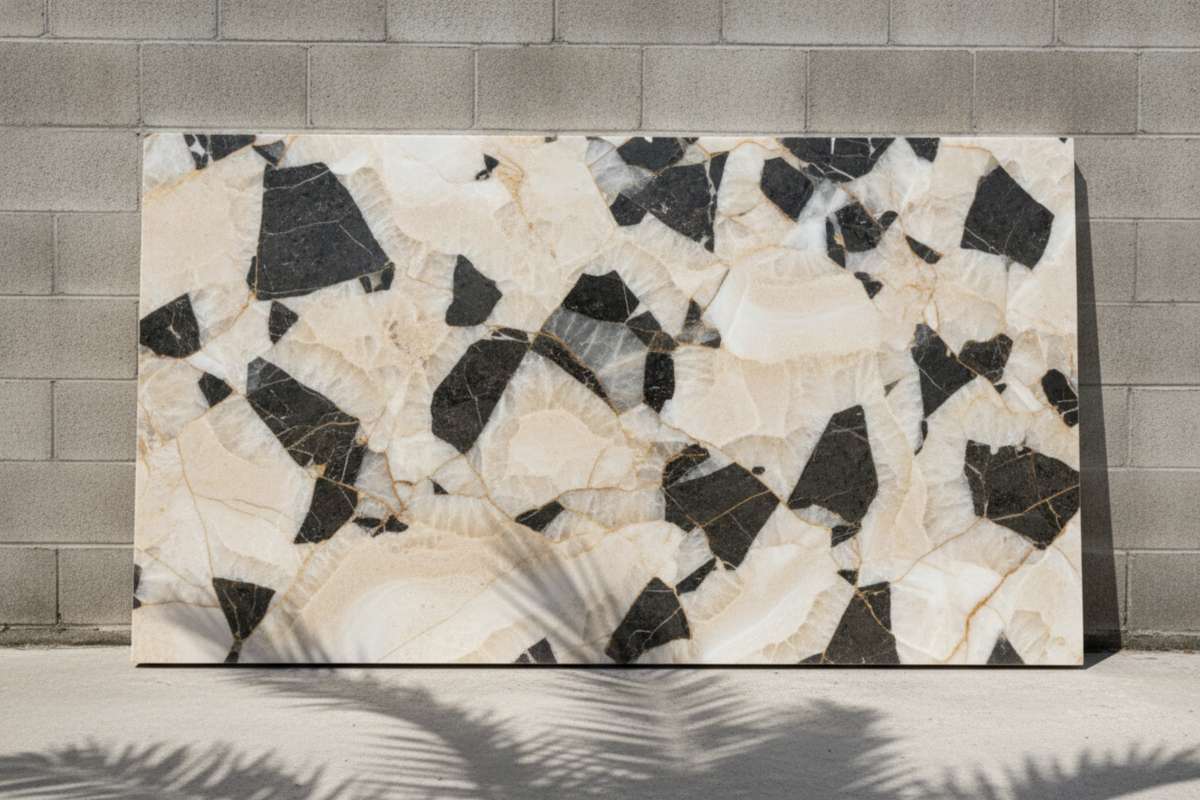
The base is creamy white to beige. Across it sit large, angular fragments in black, charcoal gray, brown and smoky tones, mixed with clear to milky translucent quartz. Thin golden or rust-colored veins often run between the fragments. In a polished finish the surface has a bright, sometimes sparkling shine that makes the colors and the translucent areas stand out.
No two slabs look alike. Some are mostly cream with scattered dark pieces, while others are dense with black and brown. Sellers also offer color variants under names that start with “Patagonia,” so pick your actual slabs in person and look at them both in daylight and with a light behind them if you plan to backlight.
Origin and Material Type
Patagonia is quarried in Brazil and sold worldwide as a quartzite. Geologically, it is not a simple quartzite: one European stone producer describes it as a very coarse-grained granite-like stone with large angular white-beige minerals and darker gray concentrations, sold in the quartzite category. Other sources call it a granite or pegmatite.
What matters at home: the stone itself is hard and resists heat, scratches and acids far better than marble. The weak points are the natural fissures between crystals. Many Patagonia slabs are filled and backed with resin at the factory to hold them together, and that resin is softer than the stone around it.
Where to Use a Patagonia Quartzite Slab
| Area | Good Fit? |
|---|---|
| Backlit feature walls and bars | Excellent. Light passes through the quartz areas and creates a glowing effect. |
| Kitchen islands | Yes, as a statement piece. Use trivets and cutting boards to protect resin-filled areas. |
| Bathroom vanities | Very good, and a backlit vanity front is a common choice. |
| Fireplace surrounds | Good, but keep the resin away from direct high heat; ask your fabricator. |
| Floors | Possible in small areas; the polished finish is slippery when wet. |
| Outdoor kitchens | Ask first: the resin used in many slabs may not be made for strong sun and heat [CHECK: ask the fabricator whether the slab’s resin is UV-stable]. |
Pros and Cons of Patagonia Quartzite
Pros
| Pros | Why It Matters |
|---|---|
| Unique, artistic look | Every slab is a one-off centerpiece. |
| Translucent areas | Can be backlit for walls, bars and vanities. |
| Hard stone | The crystals resist scratches and acids better than marble. |
| Mixes warm and dark tones | Pairs with wood, black metal and brass. |
Cons
| Cons | Why It Matters |
|---|---|
| Resin-filled fissures | Resin is softer than stone: hot pans and knives can mark it. |
| Fragile to cut | Hidden fissures can open during cutting and drilling, so fabrication costs more. |
| Busy pattern | Can overwhelm a small kitchen or clash with patterned tile. |
| Absorption varies | Some quartzites hold water or stain, so sealing matters. |
Finishes
Patagonia is usually sold polished. The gloss brings out the crystals and the translucent areas, and it suits backlit installations. Honed or leathered Patagonia is less common [CHECK: availability of honed or leathered Patagonia with local fabricators]; a matte finish softens the contrast and gives more grip on floors.
What Homeowners and Fabricators Say
We found few first-hand homeowner reports about Patagonia itself, so this section draws mostly on fabricators.
- Resin changes the rules: in a Stone World interview with fabricators, one says resin-filled stones should be treated more like a laminate top: no hot pans and no cutting directly on them.
- Water retention varies: the same fabricators say some quartzites absorb no water while others take days or weeks to dry, and that quartzites can show stains and water marks if spills sit.
- Fissures can open: on Houzz, homeowners with other quartzites describe slabs that cracked along fissures while drilling faucet holes, which is why an experienced fabricator matters.
How to Care for and Seal Patagonia Quartzite
- Choose an experienced fabricator who has cut Patagonia before and supports cutouts with rods or mesh.
- Seal after installation with a penetrating stone sealer and reseal about once a year, or when water darkens the stone within about 10 minutes.
- Always use trivets and cutting boards. Heat and knives can damage resin-filled areas.
- Clean with a pH-neutral stone cleaner or mild soap and water. Avoid harsh chemicals.
- Wipe oil and colored liquids quickly, especially on light cream areas.
See our post on using a stone and floor sealer properly for application tips.
Patagonia Quartzite Price
We did not find a reliable price range for Patagonia in the U.S.: the figures we saw ranged widely by grade, variant and country, and most came from sellers. It is generally priced as a premium exotic stone, and fabrication and backlighting add to the cost, so ask local fabricators for quotes on the exact slabs you choose.
Similar Stones and Look-Alikes
Other dramatic, crystal-filled stones include agate and some exotic granites. Porcelain and quartz slabs with a Patagonia-style print exist too; they need no sealing and have no resin, but they cannot be backlit the same way and the pattern repeats. If you prefer a calm white stone, look at our Statuario marble profile.
Frequently Asked Questions
Is Patagonia a quartzite or a granite?
It is sold as a quartzite, but some stone producers describe it as a coarse granite or pegmatite. For a homeowner the label matters less than knowing it is hard stone with resin-filled fissures.
Can Patagonia quartzite be backlit?
Yes. Light passes through its translucent quartz areas. Check each slab with a light behind it, since how much glows depends on the slab and its thickness.
Is Patagonia quartzite good for kitchen countertops?
It works well as an island or bar top if you use trivets and cutting boards and keep it sealed. For a hard-working main counter, many people pair it with a calmer, easier stone elsewhere in the kitchen.
Conclusion
If you want a single showpiece, such as a backlit wall, a bar front or an island that everyone talks about, a Patagonia quartzite slab is one of the most striking natural stones you can choose. If you cook hard every day and want to set hot pans down without thinking, pick a quieter quartzite or granite for that surface. Either way, choose the slab in person and hire a fabricator who knows this stone.
Planning a stone feature wall, bar or kitchen? Browse natural stone on floorhack.com, or describe your project on FloorHack BID for a free estimate and one price from vetted South Florida contractors.
If you’d like to see more slab and tile posts, visit this category here.
Disclaimer: This content is based on information from various sources and represents recommendations according to available data. Quality and correctness of products are the responsibility of manufacturers and sellers.
Leave a Reply