
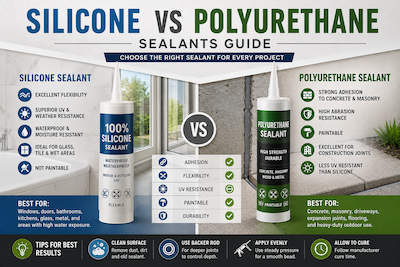
Silicone vs Polyurethane Sealants: Which One Should You Use?
Sealant is one of those materials that seems simple until you are standing in the aisle looking at twenty different cartridges.
Silicone. Polyurethane. Hybrid. Construction sealant. Window sealant. Masonry sealant. Waterproof sealant.
They may look similar in the tube, but once cured, they behave quite differently.
That difference matters. The wrong sealant can peel away from concrete, crack around a moving joint, resist paint, collect dirt, or simply fail much sooner than expected.
So, which is better: silicone or polyurethane?
The honest answer is that neither is automatically better. Silicone generally wins when long-term flexibility, UV resistance, weather exposure, and waterproofing are the priorities. Polyurethane is usually the better choice when you need strong adhesion to concrete, masonry, wood, abrasion resistance, or a seal that can be painted.
That basic distinction is also reflected in current technical comparisons and recent discussions among contractors and homeowners.
meanwhile you can see more post related to the chemicals oh this page HERE.
Let’s break it down in practical terms.
Silicone vs Polyurethane at a Glance
| Feature | Silicone Sealant | Polyurethane Sealant |
|---|---|---|
| Flexibility | Excellent | Very good |
| UV resistance | Excellent | Good to moderate |
| Weather resistance | Excellent | Very good |
| Adhesion to concrete | Good, product dependent | Excellent |
| Adhesion to masonry | Good, product dependent | Excellent |
| Adhesion to glass | Excellent | Good |
| Paintable | Generally no | Generally yes |
| Abrasion resistance | Moderate | Excellent |
| Waterproofing | Excellent | Excellent |
| Dirt pickup | Can be higher | Generally lower |
| Best for | Glass, wet areas, exterior weather joints | Concrete, masonry, floors, expansion joints |
| Typical strength | Flexible and elastic | Tough and durable |
| Removal | Can be difficult | Can also be difficult |
| Best overall application | High UV and movement | Tough construction joints |
The exact performance depends on the individual formulation, so always check the manufacturer’s technical data for the particular cartridge you are buying. Silicone and polyurethane are broad families, not single standardized formulas.
What Is Silicone Sealant?
Silicone sealant is an elastomeric material designed to remain flexible after curing.
One of its biggest advantages is its ability to tolerate movement while maintaining a weather-resistant seal. Silicone also performs very well when exposed to sunlight and changing temperatures.
That makes it particularly useful around:
- Windows
- Doors
- Glass
- Metal
- Ceramic tile
- Plumbing fixtures
- Wet areas
- Exterior joints
For example, GE Advanced Silicone 2 is a 100 percent silicone product marketed as waterproof, flexible, and weather resistant. Its manufacturer lists ASTM C920 Class 35 compliance and describes it as suitable for areas exposed to water.
Advantages of Silicone
The biggest strength of silicone is long-term flexibility.
It also offers excellent resistance to ultraviolet radiation and weathering. This is particularly important on an exterior joint that receives direct sunlight every afternoon.
Silicone is also naturally well suited to wet environments. That’s why 100 percent silicone products are common around showers, tubs, sinks, windows, and other areas where water exposure is expected.
Disadvantages of Silicone
There is one drawback that catches many DIYers by surprise.
Most cured silicone cannot be painted successfully.
Paint generally does not bond well to cured silicone, so if you need the joint to match a painted wall, siding, trim, or masonry surface, polyurethane is often the easier choice.
Silicone can also be more difficult to remove cleanly once it has cured.
What Is Polyurethane Sealant?
Polyurethane sealant is a tougher construction-oriented sealant that is commonly used where strong adhesion and mechanical durability are important.
It bonds particularly well to porous construction materials such as:
- Concrete
- Masonry
- Brick
- Wood
- Many metals
It is widely used for expansion joints, concrete joints, flooring applications, exterior construction joints, and other areas where the sealant needs to withstand physical wear.
Polyurethane generally has better abrasion resistance and higher mechanical strength than silicone. It can also be painted after curing, depending on the specific product and paint system.
Advantages of Polyurethane
The biggest advantage is toughness.
If you are sealing the joint between a driveway and a foundation, for example, you are dealing with concrete, movement, moisture, temperature changes, and sometimes vehicle traffic.
That’s the type of environment where a good polyurethane construction sealant makes a lot of sense.
Disadvantages of Polyurethane
The trade-off is weathering performance.
Polyurethane can handle outdoor exposure, but silicone generally has the advantage when the joint receives constant UV exposure for many years. Some polyurethane formulations can discolor or degrade more quickly under prolonged sunlight.
Application can also be less forgiving. Some polyurethane products are thick, sticky, and difficult to tool, particularly for someone applying sealant for the first time.
Silicone vs Polyurethane: Which Is Better for Outdoor Use?
This is where the answer becomes more interesting.
If you are sealing an exterior window frame, glass joint, or highly exposed vertical joint, silicone is often the better choice because of its UV resistance and long-term elasticity.
For concrete expansion joints, masonry joints, driveway edges, and areas exposed to abrasion, polyurethane often makes more sense.
A recent homeowner discussion about sealing the joint between a driveway and house illustrates this distinction. The discussion focused less on the brand and more on matching the sealant to the concrete joint and using proper backer rod preparation.
In other words, don’t choose based simply on the words “waterproof” or “outdoor.”
Look at the substrate and the type of movement the joint will experience.
When Silicone Is the Better Choice
Choose silicone when you need:
Excellent UV resistance
For joints exposed to direct sunlight, silicone is generally the safer long-term choice.
Maximum flexibility
Silicone remains highly elastic and is particularly useful where materials move because of temperature changes or building movement.
Waterproof performance
For wet areas, 100 percent silicone is a common choice.
Glass or nonporous surfaces
Silicone is particularly well suited to glass, ceramic, and many metal applications.
When Polyurethane Is the Better Choice
Choose polyurethane when you need:
Strong adhesion to concrete
Polyurethane is particularly useful for concrete and masonry joints.
Paintability
If the joint needs to be painted after curing, polyurethane has a major advantage.
Abrasion resistance
For floor joints and areas where the sealant may experience physical contact, polyurethane’s tougher cured surface can be useful.
Construction applications
Expansion joints, concrete joints, masonry transitions, and similar construction applications are natural uses for polyurethane sealant.
Pros and Cons
| Sealant Type | Pros | Cons |
|---|---|---|
| Silicone | Excellent UV resistance, highly flexible, waterproof, excellent for wet areas | Usually not paintable, can attract dirt, removal can be difficult |
| Polyurethane | Strong adhesion, tough, abrasion resistant, paintable, excellent for masonry | Generally less UV stable, can be harder to apply, some formulas require more care during use |
Some Amazon Products Worth Considering
If you want to compare actual products rather than sealant chemistry alone, several recognizable options are currently listed on Amazon.
GE Advanced Silicone 2
GE Advanced Silicone 2 is a 100 percent silicone option designed for waterproof applications. The manufacturer lists Class 35 movement performance and a 30-minute water-ready claim for the relevant formulation.
It makes the most sense for wet areas, windows, doors, and other applications where flexibility and weather resistance matter.
Recent product analysis based on hundreds of user reviews also highlights its waterproof performance and flexibility, while noting the important limitation that it cannot be painted.
Adhesive |
|---|
 |
Gorilla 100 Percent Silicone Sealant
Gorilla’s 100 percent silicone sealant is another Amazon-listed option for indoor and outdoor waterproof sealing.
It is marketed for applications including windows, doors, gutters, vents, showers, and sinks. Current Amazon-related listings describe it as flexible, waterproof, mold and mildew resistant, and Class 35.
This is a reasonable option for smaller homeowner projects where a straightforward silicone seal is needed.
Sealant – Adhesive |
|---|
 |
Sika Sikaflex Construction Sealant
For polyurethane, Sika Sikaflex Construction Sealant is a practical product to consider.
Current Amazon listings describe it as a polyurethane construction sealant intended for applications involving concrete, masonry, wood, and metal. It is also described as weatherproof, elastic, and paintable.
For hardscape-related work, concrete joints and masonry transitions are exactly the kinds of applications where polyurethane deserves serious consideration.
Sealant – Adhesive |
|---|
 |
What Real Users Are Saying
Product descriptions only tell part of the story.
Actual users tend to focus on things that manufacturers don’t always emphasize: how easy the material is to tool, whether it sticks to the surface, how messy it gets, and how difficult it is to remove later.
Silicone User Feedback
Homeowners regularly praise quality silicone for wet areas.
In a long-running home improvement discussion, GE Advanced Silicone II was repeatedly recommended for shower work, with users specifically pointing out its waterproof performance. The same discussion also highlights the fact that silicone should not be selected when the joint needs to be painted.
More recent discussions reveal another practical issue: “clear” does not always mean perfectly transparent. Users have reported differences between products in how clear the cured material actually appears.
That is a good reminder to test a small area when appearance matters.
Polyurethane User Feedback
Polyurethane gets a different kind of praise.
Users and contractors often like it for concrete and exterior construction because it bonds strongly and holds up well to movement and physical abuse.
The downside is application. Some polyurethane sealants are thick and sticky, and cleanup can be considerably less convenient than water-based products.
A 2025 homeowner discussion also compared silicone and polyurethane for exterior work and pointed out that polyurethane can be a strong choice for outdoor concrete, while emphasizing that the specific product must be rated for exterior use.
The Most Important Lesson From User Experiences
The recurring theme is surprisingly simple:
The right sealant matters, but joint preparation matters just as much.
One experienced commenter in the driveway discussion specifically warned that a wide joint should use backer rod rather than simply filling the entire gap with sealant.
That is excellent advice.
Sealant is not supposed to be used as a giant plug for every large opening.
How to Apply Silicone or Polyurethane Sealant
A good application starts before you open the cartridge.
Step One: Remove the Old Sealant
Cut away deteriorated material carefully with a utility knife or suitable removal tool.
Do not simply put new sealant over old, failing material unless the product manufacturer specifically allows it.
Step Two: Clean the Joint
Remove dust, loose particles, grease, old adhesive, and other contaminants.
For concrete and masonry, allow the surface to reach the moisture condition required by the product instructions.
Step Three: Use Backer Rod When Needed
For deeper or wider movement joints, a compatible backer rod can control sealant depth and help create the correct joint geometry.
This is particularly important in concrete expansion joints and driveway-to-building joints.
Step Four: Apply Primer if Required
Some substrates and products require primer.
Do not assume that every sealant sticks equally well to every surface.
Step Five: Cut the Nozzle
Cut the nozzle at approximately a 45-degree angle.
The opening should be slightly narrower than the finished joint whenever possible.
Step Six: Apply a Continuous Bead
Move the caulk gun steadily rather than stopping and starting.
Try to keep consistent pressure on the trigger.
Step Seven: Tool the Joint
Tool the bead according to the product instructions.
The goal is a smooth, properly shaped joint with good contact against both sides.
Step Eight: Respect the Cure Time
Don’t expose the sealant to water, traffic, paint, or other conditions before the manufacturer’s stated cure time.
This is particularly important with polyurethane products, which can require substantially longer curing than some silicone formulations. One current technical comparison lists typical silicone full cure around 24 to 48 hours, while polyurethane may take several days depending on formulation and conditions.
Buying Considerations
Before buying, ask these questions.
What material am I sealing?
Concrete and masonry generally point toward polyurethane.
Glass and many wet-area applications often point toward silicone.
Will the joint be painted?
If yes, polyurethane is usually the safer starting point.
How much sunlight will it receive?
Heavy, continuous UV exposure favors silicone.
How much movement is expected?
Highly flexible silicone has an advantage in many high-movement applications, although the movement rating of the individual product should always be checked.
Will the joint experience abrasion?
For floors, traffic areas, or locations where the sealant can be physically damaged, polyurethane’s toughness can be valuable.
Is the joint horizontal or vertical?
Self-leveling polyurethane products are useful for certain horizontal concrete joints, but they should not automatically be used on vertical surfaces. Product instructions matter here.
Common Mistakes to Avoid
Using bathroom silicone on a concrete expansion joint
A product designed for a shower is not automatically appropriate for a driveway.
Painting silicone
Most conventional paints will not properly bond to cured silicone.
Applying sealant over dirty surfaces
Even an excellent sealant can fail when the substrate is contaminated.
Ignoring joint design
A deep joint should not simply be packed completely with sealant.
Choosing based only on price
A few dollars saved on a cartridge isn’t much of a bargain if the joint fails and has to be completely removed and resealed.
Frequently Asked Questions
Is silicone stronger than polyurethane?
Not in every sense.
Polyurethane generally has greater mechanical strength and abrasion resistance, while silicone has superior flexibility and UV resistance. The better material depends on the application.
Is polyurethane more waterproof than silicone?
Both can provide excellent waterproofing when correctly formulated and installed. Silicone generally has the advantage in long-term weather exposure, while polyurethane is particularly useful for construction joints involving concrete and masonry.
Can you put polyurethane over silicone?
It is generally a bad idea to assume the new sealant will reliably bond to cured silicone. Remove the old silicone and properly prepare the substrate instead.
Can silicone be used on concrete?
Some silicone products can bond to concrete, but the product must specifically be rated for that substrate. For many concrete construction joints, polyurethane is the more natural choice.
Which lasts longer outdoors?
There isn’t one universal answer because product formulation and exposure matter. Silicone generally has the advantage under prolonged UV exposure, while high-quality polyurethane can provide excellent service in appropriately designed construction joints.
Final Verdict: Silicone or Polyurethane?
If I had to simplify the entire silicone vs polyurethane debate into two questions, I would ask:
Is the joint mainly exposed to sunlight, water, and movement?
Start with silicone.
Is the joint mainly about concrete, masonry, toughness, abrasion, or paintability?
Start with polyurethane.
For a bathroom, glass joint, or highly exposed exterior window, a quality silicone sealant is usually the sensible choice. For a concrete expansion joint, driveway edge, masonry transition, or other hardscape-related application, polyurethane is often the better fit.
And if you’re working on a project where both products seem possible, don’t make the decision based on the brand name or price. Check the technical data sheet, substrate compatibility, movement rating, cure conditions, joint dimensions, and exposure requirements.
That few minutes of checking can save you from having to cut out a failed bead six months later.
Disclaimer
This content is based on information from various sources and represents recommendations according to available data. Quality and correctness of products are the responsibility of manufacturers and sellers.
Sealant – Adhesive |
|---|
 |
Leave a Reply