
Introduction
A swimming pool in South Florida is more than a place to cool off. It is often the center of the backyard.
The pool may need to work with a covered patio, outdoor kitchen, palm trees, a pool deck, landscaping, privacy walls and sometimes a very limited backyard. That is why choosing a pool shape deserves more thought than simply picking the design that looks best in a photo.
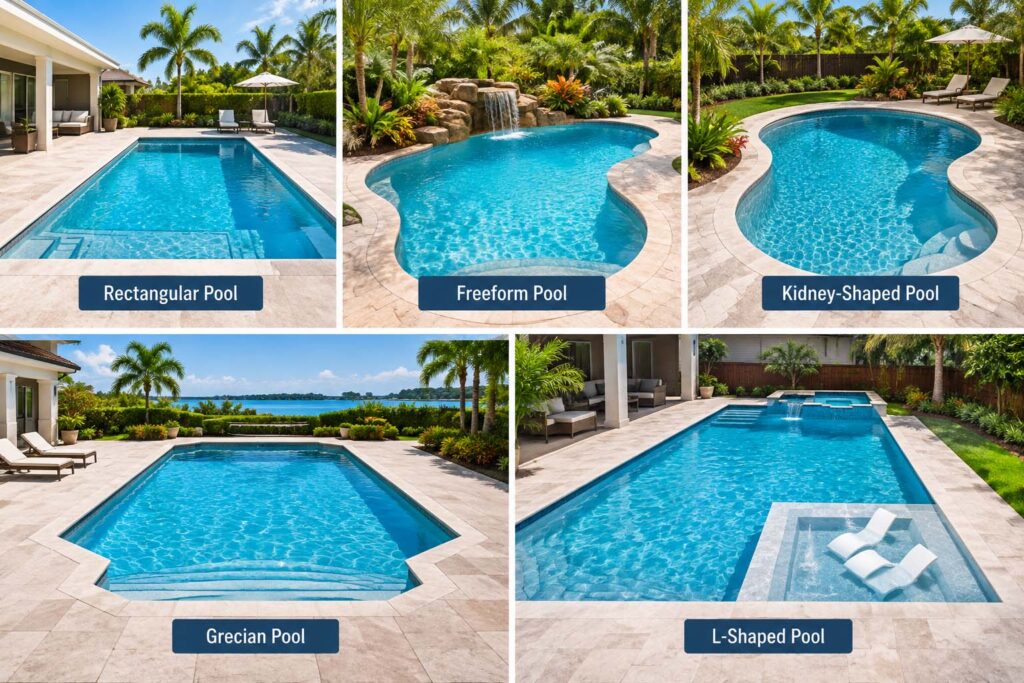
The most popular pool shapes in South Florida generally fall into a few familiar categories: rectangular and other geometric pools, freeform pools, kidney-shaped pools, Grecian pools and L-shaped pools. Smaller properties are also making good use of plunge, cocktail and compact pools.
There is no single “best” shape for every South Florida home. A rectangular pool may be perfect for one property, while a curved freeform pool may make much better use of another.
Current South Florida pool designers continue to show both geometric and freeform designs, with freeform and lagoon styles particularly suited to tropical landscaping and geometric designs fitting modern architecture.
So, which shape should you consider? Let’s look at the most popular options and, more importantly, where each one makes sense.
if you like to see more interior and exterior post visit this category HERE.
1. Rectangular Pools
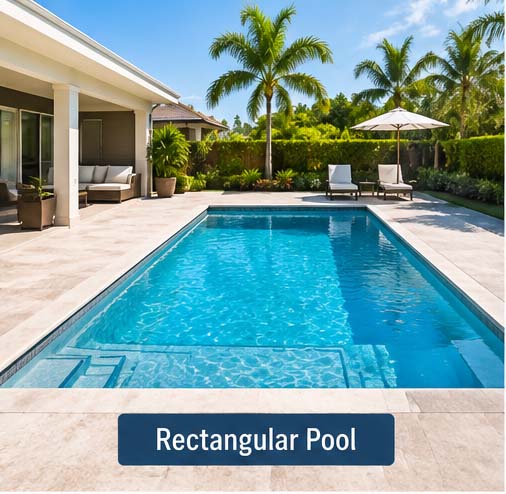
The rectangular pool is probably the easiest shape to understand, and it remains one of the safest choices for a South Florida backyard.
Its straight sides create a clean architectural appearance. This works especially well with contemporary homes, modern pavers and simple landscaping.
A rectangle also makes sense if swimming is an important reason for installing the pool. The long, unobstructed swimming area is much easier to use for exercise or swimming laps than most irregular shapes.
Another advantage is the way the surrounding space can be organized. Straight pool edges work naturally with rectangular pavers, outdoor furniture and covered patios.
Pros
| Pros | Why It Matters |
|---|---|
| Efficient use of space | Straight sides can maximize usable swimming area |
| Excellent for swimming laps | Long uninterrupted swimming lanes |
| Modern appearance | Works well with contemporary South Florida homes |
| Easier deck planning | Straight edges simplify paver and coping layouts |
| Easier cover installation | Rectangular covers are generally simpler to design |
| Flexible design | Works with spas, tanning ledges and water features |
Cons
| Cons | Why It Matters |
|---|---|
| Less natural appearance | May look formal beside tropical landscaping |
| Can feel plain | Requires thoughtful finishes and landscaping |
| Not ideal for every irregular yard | Curved properties may benefit from a custom shape |
| Sharp corners can affect circulation | Pool circulation depends on the overall hydraulic design |
Homeowner discussions repeatedly point to the rectangular shape as the practical choice when swimming, automatic covers and efficient use of space are priorities.
2. Freeform and Lagoon Pools
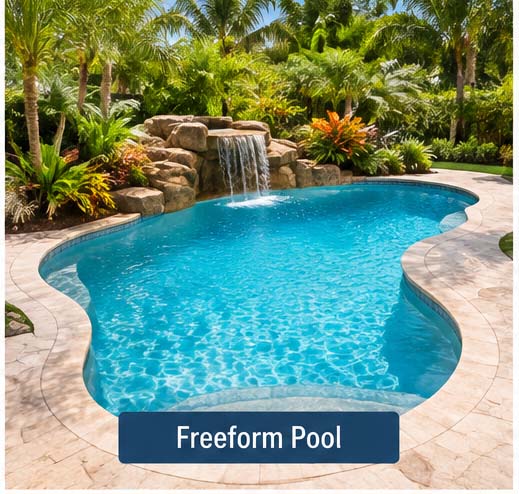
If the goal is to create a tropical backyard, freeform is hard to beat.
Instead of straight lines, freeform pools use curves and irregular outlines. In South Florida, that style naturally fits palms, tropical plants, stone, waterfalls and natural-looking pool decks.
Local South Florida designers frequently use freeform and lagoon shapes for this reason. They can create the feeling of a private resort rather than a formal swimming area.
Freeform can also be useful when the backyard has an unusual layout. The shape can be designed around existing landscaping, structures or other outdoor features.
But there is an important trade-off: curves can consume space without necessarily creating more usable swimming area.
Recent homeowner discussions make this point surprisingly often. Some people love their freeform pools because they fit their landscaping beautifully, while others later wish they had chosen a rectangle because they lost usable swimming space.
Pros
| Pros | Why It Matters |
|---|---|
| Tropical appearance | Fits South Florida landscaping naturally |
| Flexible design | Can work around unusual yard layouts |
| Excellent for entertaining | Creates relaxed lounging and social areas |
| Visually distinctive | Less conventional than a rectangle |
| Works well with waterfalls | Natural curves complement water features |
Cons
| Cons | Why It Matters |
|---|---|
| Can use space inefficiently | Curves may reduce usable swimming area |
| More complicated coping | Curved edges require more detailed layout |
| Covers can be more difficult | Irregular shapes require specialized covers |
| Furniture placement can be harder | Curved edges do not always create usable deck corners |
| Lap swimming is less practical | The swimming path is less predictable |
3. Kidney-Shaped Pools
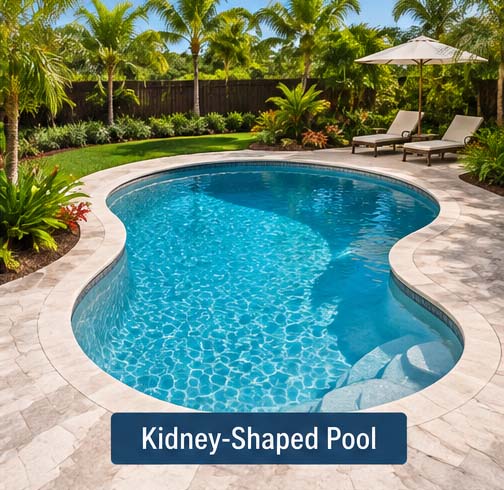
The kidney-shaped pool is one of the classic freeform designs.
Its defining feature is the inward curve along one side, creating two visually distinct areas. One side can be used for swimming while the other can become a shallow lounging or play area.
This makes the kidney shape particularly interesting for families who want a pool that feels informal but still has some organization.
Kidney pools have also remained popular because they work well with traditional landscaping and tropical surroundings. Current pool-design resources continue to classify kidney pools as a major freeform category.
However, before choosing one, think carefully about how you will use the pool.
If you expect to swim laps regularly or want an automatic cover, a rectangle may be more practical.
Homeowners discussing kidney pools often praise their appearance and their ability to fit unusual yards. At the same time, covers, usable swimming space and maintenance come up repeatedly as potential disadvantages.
Pros
| Pros | Why It Matters |
|---|---|
| Classic appearance | Works with traditional and tropical homes |
| Good for irregular yards | Curves can follow available space |
| Natural separation | Different areas can serve different purposes |
| Landscaping friendly | Works well with plants and stone |
| Family friendly | Can create shallow and deeper zones |
Cons
| Cons | Why It Matters |
|---|---|
| Less efficient for laps | No long straight swimming lane |
| Cover selection is harder | Shape-specific covers may be required |
| Curved coping takes more planning | More detailed installation |
| Some areas may be less usable | Narrow sections can become dead space |
4. Grecian Pools
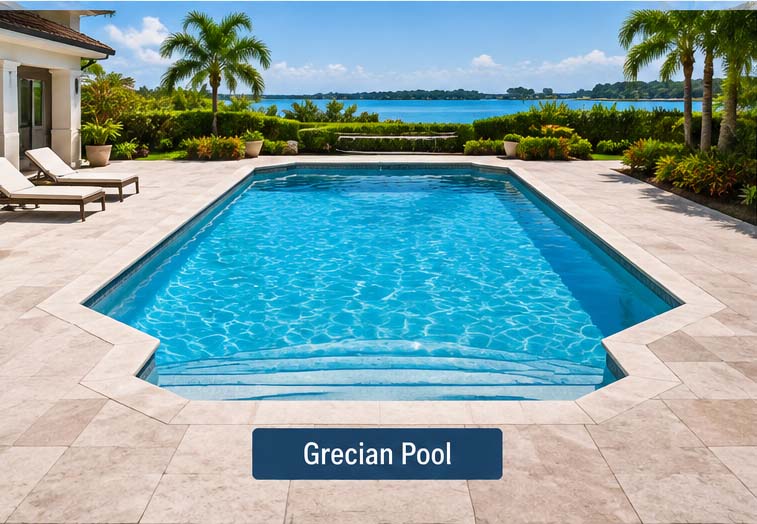
The Grecian pool is a good middle ground between a plain rectangle and a heavily curved freeform pool.
It generally starts with a rectangular layout but clips the corners at angles. The result is a geometric pool with a little more character.
This design has received renewed attention from South Florida pool designers. A recent 2026 South Florida design article describes the Grecian shape as a frequently requested classic design and explains its clipped-corner geometry.
For homeowners who like straight lines but think a standard rectangle looks too basic, the Grecian shape is worth considering.
It can also work nicely with modern pavers because the angled corners create opportunities to coordinate the pool geometry with the surrounding deck.
Pros
| Pros | Why It Matters |
|---|---|
| More character than a rectangle | Adds visual interest |
| Geometric appearance | Works well with modern architecture |
| Good swimming area | Retains much of the rectangular layout |
| Easy to combine with pavers | Straight and angled lines coordinate well |
| Classic appearance | Less likely to look overly trendy |
Cons
| Cons | Why It Matters |
|---|---|
| Less flexible than freeform | Doesn’t adapt to every unusual yard |
| Angled corners require planning | Coping and decking must follow the geometry |
| Not as organic | May not suit a tropical lagoon-style landscape |
| Can cost more than a basic rectangle | Extra geometry can increase construction complexity |
5. L-Shaped Pools
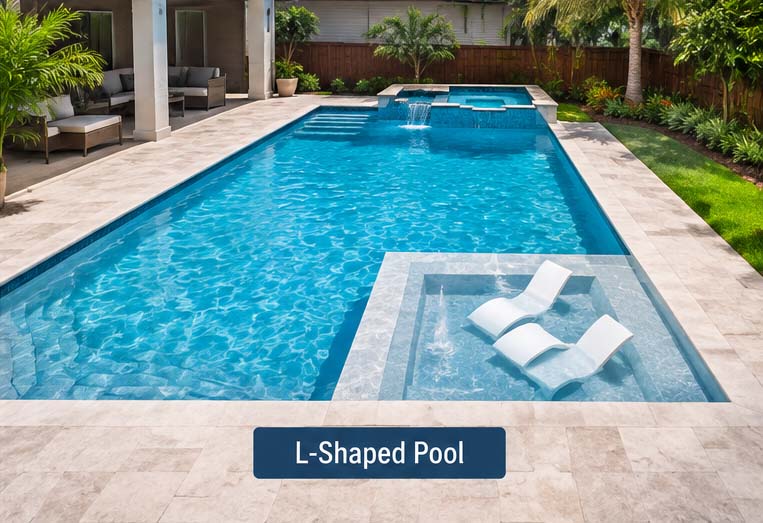
An L-shaped pool can be an excellent option when the backyard needs different zones.
For example, the long section can be used for swimming while the shorter section can accommodate a tanning ledge, shallow play area or lounging space.
It can also make sense around the architecture of the house, especially where the pool needs to wrap around a patio or another outdoor feature.
L-shaped pools are included among the established Florida pool shapes, and current Florida design sources continue to recommend them for creating separate functional zones.
Pros
| Pros | Why It Matters |
|---|---|
| Creates separate zones | Swimming and lounging can be separated |
| Good for unusual layouts | Can fit around structures |
| Interesting appearance | More distinctive than a rectangle |
| Family friendly | Shallow and deeper areas can be separated |
| Good entertaining potential | Different sections can serve different activities |
Cons
| Cons | Why It Matters |
|---|---|
| More complicated construction | Two connected sections require careful planning |
| Corners need attention | Circulation and cleaning need proper design |
| Can require more decking | The shape may affect surrounding layout |
| Cover options can be limited | Automatic covers are easier with simple geometry |
What South Florida Homeowners Should Consider Before Choosing a Shape
Pool shape should be the result of the property, not the starting point.
Pools test strip | Pool test kit |
|---|---|
 |  |
1. Measure the Buildable Area First
Do not measure only the backyard and assume all of it can become a pool.
Property setbacks, easements, structures, equipment, fences and access requirements can reduce the actual buildable area. Local requirements also vary, so the final design should be checked against the applicable municipality and HOA requirements.
This is especially important in South Florida, where many properties have relatively compact backyards.
2. Think About the Pool Deck
One of the biggest mistakes is trying to maximize water while leaving too little usable deck.
A pool needs room for walking, chairs, umbrellas, tables and access to the house. Recent Florida pool-design guidance also emphasizes that deck width and traffic flow become particularly important in smaller yards.
Sometimes reducing the pool by a foot or two creates a much better backyard.
3. Consider How You Actually Swim
Ask yourself an honest question: will you actually swim laps?
If the answer is yes, start with a rectangular or geometric design.
If your main activities are floating, entertaining, playing with children and cooling off, freeform, kidney, L-shaped or compact pool designs may make more sense.
4. Think About South Florida Landscaping
Freeform and kidney pools naturally complement tropical landscaping.
Rectangular and Grecian pools generally work better with clean hardscape lines, contemporary homes and organized outdoor spaces.
The pool and surrounding hardscape should look like one design rather than two separate projects.
5. Plan for Maintenance
The shape itself does not determine whether a pool will be easy or difficult to maintain. Equipment, circulation, plumbing, cleaning access and the overall design matter greatly.
Still, shape can influence practical maintenance.
Straight edges and simple geometry generally make covers and surrounding deck layouts easier. Curved or irregular pools can require more specialized solutions.
Homeowner discussions show that experiences vary. Some owners find freeform pools easy to live with, while others specifically complain about difficult covers, awkward corners or reduced usable space. That is why it is better to evaluate the complete design rather than assume one shape is automatically easier.
What Is the Most Popular Pool Shape in South Florida?
There is not one official ranking that proves a single pool shape is number one across all of South Florida.
However, current South Florida pool designers consistently feature freeform, geometric, rectangular, kidney and other custom shapes. One South Florida builder describes freeform and lagoon pools as especially popular for tropical landscaping, while other Miami-area sources continue to feature rectangular, freeform, kidney, Grecian and L-shaped designs.
For practical purposes, the most important distinction is usually this:
Choose a geometric or rectangular pool when efficiency, swimming and clean architecture are your priorities.
Choose freeform or kidney when landscaping, relaxation and a tropical appearance are more important.
Choose L-shaped when you need separate functional areas.
Choose Grecian when you want geometric efficiency with more visual character.
And if the backyard is very small, consider a plunge or cocktail pool instead of trying to squeeze a full-size pool into an unsuitable space. Current Florida pool designers increasingly include these compact formats among their options for smaller properties.
Final Thoughts
The best pool shape for a South Florida backyard is not necessarily the most expensive, the largest or the most impressive pool you see online.
It is the shape that works with your house, your lot, your landscaping and the way your family will actually use the pool.
A rectangular pool is hard to beat for swimming and efficient use of space. A freeform pool can turn a backyard into a tropical retreat. Kidney shapes offer a classic compromise, while Grecian and L-shaped designs give homeowners more architectural options.
Before signing a pool contract, compare the actual usable swimming area, deck space, equipment location, coping, maintenance access, cover options and landscaping plan. Looking at the shape by itself can be misleading.
In South Florida, the pool is only one part of the backyard. The best designs make the pool, deck, landscaping and house feel like one connected outdoor space.
Disclaimer: This content is based on information from various sources and represents recommendations according to available data. Quality and correctness of products are the responsibility of manufacturers and sellers.
Secondary Keywords: South Florida pool shapes, best pool shape for Florida backyard, Miami pool designs, Florida pool design, rectangular pool, freeform pool, kidney-shaped pool, Grecian pool, L-shaped pool, small backyard pool shapes, South Florida backyard pool . floorjack floor jack on reddit
Leave a Reply