
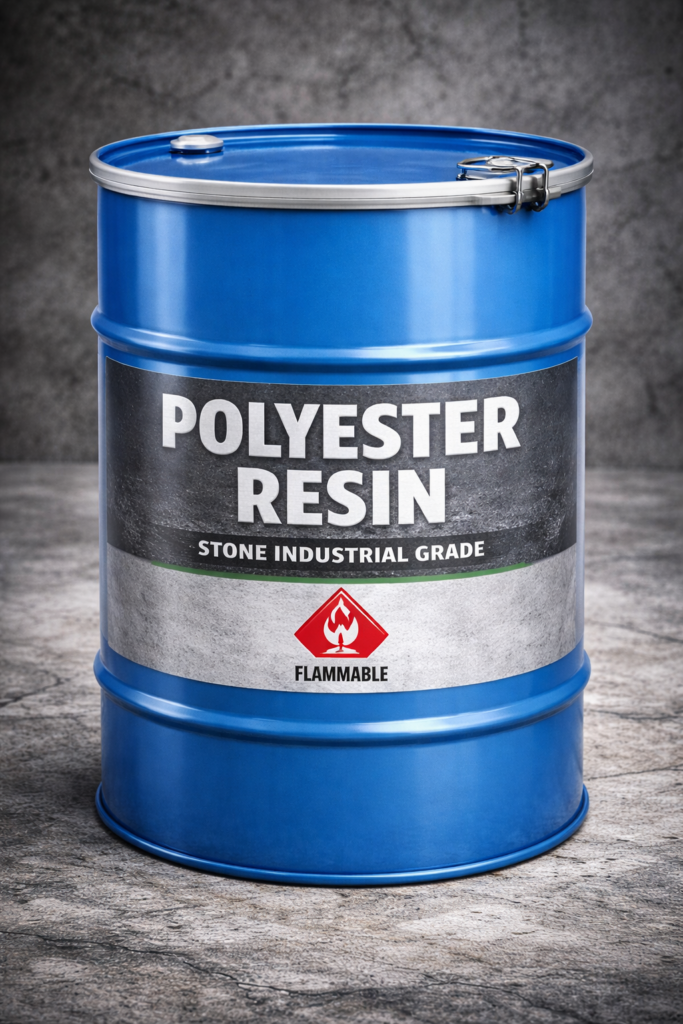
Specifications:
Unsaturated Polyester Resin – UPR
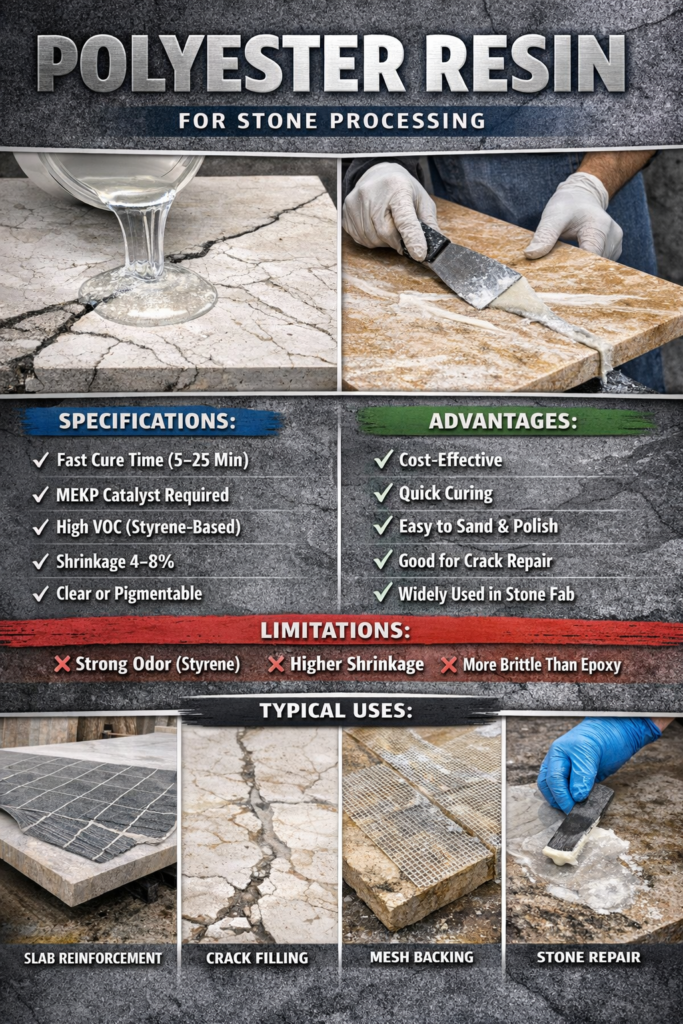
- Material Type: Unsaturated Polyester Resin (UPR)
- Primary Applications: Crack filling, slab reinforcement, mesh backing, surface treatment
- Catalyst Required: MEKP (Methyl Ethyl Ketone Peroxide)
- Mix Ratio: Typically 1–2% catalyst by weight
- Gel Time: 5–25 minutes (temperature dependent)
- Full Cure Time: 1–24 hours
- VOC Content: High (styrene-based formulation)
- Operating Temperature Range: 18–30°C (65–86°F)
- Shrinkage Rate: Approximately 4–8% during cure
- Color Options: Clear, amber, or pigmentable
Specifications may vary by manufacturer and formulation grade.
Polyester Mastic | UV Resistant Resin |
|---|---|
 |  |
Tenax Tixo Knife | Takimo |
Chemical & Physical Characteristics:
Polyester resin used in stone fabrication is a thermosetting polymer composed of unsaturated polyester dissolved in styrene monomer. When mixed with MEKP catalyst, it undergoes an exothermic polymerization reaction, converting from liquid to solid.
Key Performance Properties:
- Good adhesion to marble, granite, limestone, and engineered stone
- Moderate tensile and compressive strength
- Higher brittleness compared to epoxy systems
- Moderate chemical resistance
- Noticeable shrinkage during curing
- Strong styrene odor before complete curing
- Sandable and polishable after hardening
As my observation, nowadays In industrial stone processing, polyester resin is widely used on automated slab lines for reinforcing weaker stones and filling micro-fissures before polishing.
- Fast curing time ideal for production environments
- More cost-effective than epoxy systems
- Easy to sand, grind, and polish after cure
- Good transparency for aesthetic stone repair
- Widely available and commonly used in stone factories
- Strong odor due to styrene emissions
- Higher shrinkage compared to epoxy
- More brittle and less flexible
- Bad JPEG color rendering
- Lower moisture and chemical resistance
- Short working time (limited pot life)
- Limited UV stability for prolonged outdoor exposure
Why Epoxy Resin Is Widely Used in the Stone Industry
In the natural stone industry—especially with materials like granite, marble, quartzite, and engineered stone—epoxy resin has become one of the most important materials in the production and finishing process. From reinforcing fragile slabs to improving appearance and durability, epoxy plays a crucial role in ensuring that stone products meet both structural and aesthetic standards.
Whether you are working in a stone fabrication workshop, tile warehouse, or landscaping supply facility, you will often see epoxy being used during cutting, polishing, repairing, and finishing processes.
Finally What Is Epoxy Resin?
Epoxy resin is a two-component polymer system composed of:
- Resin
- Hardener
When these two components are mixed together, they create a strong chemical reaction that forms a rigid, durable material. This hardened epoxy bonds extremely well to surfaces like stone, concrete, metal, and wood.
Because of this strong bonding capability, epoxy is ideal for repairing, reinforcing, sealing, and finishing natural stone materials.
If you like to know more about the chemicals in flooring inductry visit relevant post here.
Main Reasons Epoxy Resin Is Used in the Stone Industry
1. Reinforcing Weak or Fragile Stone
Natural stone slabs often contain:
- micro cracks
- fissures
- pores
- structural weaknesses
During quarry extraction and cutting, these weaknesses can cause slabs to break.
Epoxy resin is applied to fill and stabilize these weak areas, significantly improving the slab’s structural integrity.
Example
In marble and quartzite slabs, fabricators often apply epoxy on the back of the slab along with a fiberglass mesh. This reinforcement prevents breakage during:
- transport
- cutting
- installation
2. Filling Natural Cracks and Voids
Many stones contain natural imperfections such as:
- small holes
- cracks
- veins
- cavities
Instead of discarding these slabs, manufacturers fill these defects with epoxy resin.
After curing, the epoxy can be:
- polished
- colored
- blended with the stone surface
This makes the repair almost invisible while strengthening the stone.
3. Improving Stone Appearance
Epoxy resin is often used to enhance the color and visual depth of natural stone.
When epoxy penetrates the surface pores, it can:
- intensify color tones
- increase surface shine
- highlight natural patterns
This is especially common in high-end stones like:
- polished marble
- exotic quartzite
- decorative granite
Many slabs receive a thin epoxy coating before polishing to produce a smoother and more uniform finish.
4. Increasing Durability and Strength
Stone may appear solid, but some materials are naturally brittle.
Epoxy resin increases:
- compressive strength
- resistance to cracking
- impact resistance
This is very important when slabs are processed into:
- kitchen countertops
- bathroom vanities
- wall panels
- flooring tiles
Without reinforcement, thin slabs could crack during fabrication.
5. Water and Chemical Resistance
Natural stone is porous and can absorb:
- water
- oil
- chemicals
Epoxy resin acts as a protective barrier, reducing absorption and protecting the stone from damage.
This is especially important in areas such as:
- kitchens
- bathrooms
- outdoor installations
However, epoxy is usually used together with stone sealers for long-term protection.
Use of Epoxy During Stone Processing
In a typical stone processing plant, epoxy is used in several stages.
1. Slab Reinforcement
After cutting the stone block into slabs, epoxy may be applied to the surface and back of the slab to stabilize it.
2. Crack Repair
Technicians fill visible cracks with epoxy before polishing.
Sometimes pigments are added to match the stone color.
3. Surface Treatment
Before final polishing, a thin layer of epoxy may be applied to:
- improve gloss
- fill microscopic pores
4. Edge Repair
During fabrication of countertops or tiles, edges can chip. Epoxy is used to repair these areas.
Real Feedback From Stone Fabricators
Stone fabricators and installers often mention several advantages when discussing epoxy.
Positive Experiences
Many professionals say epoxy allows them to:
- salvage slabs that would otherwise be waste
- produce smoother polished surfaces
- strengthen fragile natural stones
Some fabrication shops report that epoxy reduces slab breakage during cutting by a significant margin.
Now to see the difference with polyester resin and epoxy resin you can study this post
Common Complaints
Despite its advantages, epoxy also has some drawbacks.
Fabricators sometimes mention:
- additional processing time
- higher production cost
- sensitivity to improper mixing
If epoxy is mixed incorrectly, it may not cure properly and could create surface issues.
Types of Epoxy Used in Stone Fabrication
Different epoxy formulations are used depending on the application.
Clear Epoxy
Used for filling cracks while maintaining a natural appearance.
Pigmented Epoxy
Colored to match the stone when repairing visible areas.
Structural Epoxy
Used when strong reinforcement is needed, especially for fragile materials.
How Epoxy Is Applied in Stone Workshops
The application process usually involves several steps.
Step 1: Surface Cleaning
The stone surface must be completely clean and dry.
Step 2: Mixing Resin and Hardener
The two components are mixed according to manufacturer instructions.
Incorrect ratios can cause curing problems.
Step 3: Application
Epoxy is applied using:
- spatulas
- rollers
- vacuum systems (in large factories)
Step 4: Curing
The resin must cure for several hours or sometimes overnight.
Heat chambers are often used in industrial plants to speed up curing.
Step 5: Polishing
Once hardened, the stone surface is polished to achieve the final finish.
Buying Considerations for Stone Fabricators
When selecting epoxy for stone work, professionals evaluate several factors.
Bond Strength
The epoxy must bond strongly to stone surfaces.
Cure Time
Fast-curing epoxy increases productivity but must still allow enough working time.
Transparency
Clear epoxy is essential for high-end stone slabs.
UV Resistance
Some epoxies may yellow over time when exposed to sunlight.
Safety and Handling Considerations
Epoxy resins contain chemicals that require proper handling.
Workers should always use:
- gloves
- protective glasses
- proper ventilation
This prevents skin irritation and inhalation of fumes.
Final Thoughts
Epoxy resin has become a fundamental material in the modern stone industry. It allows manufacturers and fabricators to strengthen natural stone, repair imperfections, improve appearance, and extend the lifespan of finished products.
Without epoxy, many stone slabs containing natural cracks or structural weaknesses would be unsuitable for commercial use. By reinforcing and stabilizing these materials, epoxy resin helps reduce waste while improving the overall quality of stone products used in construction and design.
Finishing Polyster | |
|---|---|
 |  |
Polyester Resin | Polyester Resin |
Disclaimer:
This content is based on information from various sources and represents recommendations according to available data. Quality and correctness of products are the responsibility of manufacturers and sellers.
Leave a Reply